We need to recognize, that our understanding of colors are different that the understanding of people who lived many years or centuries ago. We are under pressure not only material world around us, but also virtual world that gives us information that we are not as perfect as pictures after Photoshop program.
It is necessary to forget about commercial or psychological understanding of colors.

To understand beauty of true colors we should go back to the nature and not to beautiful pictures in the Internet, but to accept the whole picture with sounds, wind, smell, colors and feelings to be energetic or tired... and remind to yourself about the Creator.
Than you can try to understand colors in
Icons that are a visual part of
Liturgy, like color of water is not only color of the river but also of the sky reflection and etc.
It is true that chosen colors or color harmony by an iconographer depends of pigments, traditions of the country, schools, century, spiritual life and many other. Every ancient icon can give us the message. And it is a language to discover.
We can start from simple symbols.
Icons: Symbolism In Color.
"Holy Faces"Hieromonk Tikhon (Kozushin)
An introductory discussion on the symbolism of colors in icons Byzantines considered that the meaning of art is beauty. They painted icons that shined with metallic gold and bright colors. In their art each color had its place and value. Colors – whether bright or dark – were never mixed but always used pure. In Byzantium, color was considered to have the same substance as words, indeed each color had its own value and meaning. One or several colors combined together had the means to express ideas. Being trained in Byzantine art, Russian master-iconographers accepted and preserved the symbolism of color. Russian icons did not achieve the same magnificence and austerity as the art of imperial Byzantium. However, colors in Russian icons attained a brightness that was livelier and more vibrant. The iconographers of ancient Russia learned to create works close in inspiration to local conditions, tastes and ideals.
Gold


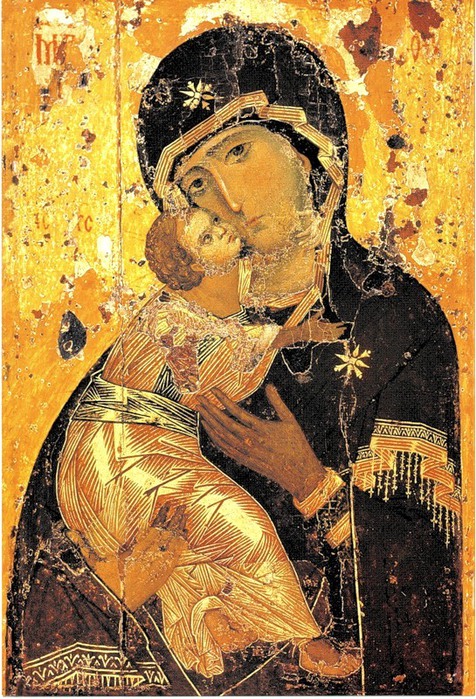
The brilliance of gold in mosaics and icons made it possible to feel the radiant light of God and the splendor of the celestial kingdom where there is never any night. Gold symbolized the divine nature of God himself. This color glimmers with different nuances in the icon of the Mother of God of Vladimir.
Purple

Purple, or crimson, was a color very important in Byzantine culture. This is the color of the Celestial King and the Byzantine emperor, whom Andrew Grabar called “God’s Lieutenant on earth.” Only the Byzantine emperor could sign edicts in purple ink and sit in glory upon a purple throne, and it was only he who wore purple clothing and boots – for all others it was strictly forbidden. The leather or wood bindings of the Gospel in churches were sometimes covered with purple cloth. This color is present in icons on the clothing of the Mother of God – the Celestial Queen.
Red

Red is one of the most frequently used colors in icons. This is the color of heat, passion, love, life and life-giving energy, and for this very reason red became the symbol of the resurrection – the victory of life over death. But at the same time it is the color of blood and torments, and the color of Christ’s sacrifice. Martyrs are depicted in red clothing on icons.

In red celestial fire blaze the wings of the Seraphim – angels stationed adjacent to God’s throne.

Sometimes icons were painted with a red background as a symbol of the celebration of eternal life.
White


White is the symbol of the heavenly realm and God’s divine light. (Figure 3) This is the color of cleanliness, holiness and simplicity. On icons and frescoes, saints and righteous people are usually depicted clothed in white as righteous ones – people who were good, honest, and lived by “the Truth.” In the same manner, white was used in the swaddling bands of babies, the shrouds of the dead and the robes of angels. Only righteous souls were depicted as wearing white.
Dark-Blue and Blue


Dark-blue and blue indicate the infiniteness of the sky and is the symbol of another everlasting world. Dark blue was considered the color of the Mother of God who combines in her self both the terrestrial and celestial. The backgrounds of mural paintings in many Byzantine churches dedicated to the Mother of God are filled with a celestial dark blue.
Green


Green is the color of natural, living things. It is the color of grass and leaves, youth, flowering, hope, and eternal renovation. Ancient iconographers often painted the earth green to denote where life began – such as in scenes of the Annunciation (Figure 4) and the Nativity.
Brown

Brown is the color of the bare earth, dust, and all that is transient and perishable. Used in combination with the royal purple clothing of the Mother of God, this color reminds one of her human nature, which was subject to death.
Black

Black is the color of evil and death. In iconography, caves were painted with the color black as a symbol of humankind’s grave and the gaping infernal abyss. In some subjects this was also the color of mystery. For example, against a black background, which indicated the incomprehensible depth of the universe, icon painters depicted Cosmos – an old man with a crown – in the icon of the Pentecost or Descent of Holy Spirit. The black robes of monks, who have left the path of worldly life, are a symbol of their eschewing the pleasures and habits they formerly kept, and dying a death toward this way of life.
Colors Not Used in Iconography
A color that was never used in iconography is gray. When mixing black and white together, iniquity and righteousness, it becomes the color of vagueness, the color of the void and nonexistence. There was no place for this color in the radiant world of the icon.
http://www.pravmir.com/icons-symbolism-in-color/
Images are from free Internet sources.
 Our dear friends, we had to change the location of the Phillip Davydov's course of iconography: